
AnyKey Cafe · Research Case Notebook · Working hypothesis
Where two geometries appear to meet
The Genesis Chamber is a new name for a possible relationship among square diagonals, close-packed triangular geometry, recurrence at two and three, and a six-count where the two patterns may meet. It is a question under construction, not a discovered object or an established mechanism.

Three threads enter the room
Each subject already has its own history. The chamber begins only where we ask whether their relationships can be expressed in one testable model.
Square grammar
The diagonal and √2
A unit square has a diagonal of √2 units. That relationship is ordinary, exact geometry even though its decimal expansion never terminates or repeats. The new question is whether diagonal traversal also marks a repeatable change of phase, orientation, or recurrence in a larger model.
Close-packed grammar
Triangles, hexagons, and 120°
Equal circles and close-packed points naturally produce triangular and hexagonal relationships. Three directions meet with 120° separation, and sixfold symmetry appears around equivalent nodes. The Flower of Life is one visual doorway into this family of relationships.
Recurrence grammar
Two, three, and the meeting at six
Two and three first share an integer multiple at six. That arithmetic fact does not by itself establish a physical cycle. Here it provides a disciplined question: can a square-based repeat and a triangular-based repeat be defined so that both return together at a six-step state?
The proposed crossing
The working image is a conversion relationship between two coordinate grammars, with √2 refusing to collapse into a simple integer count.
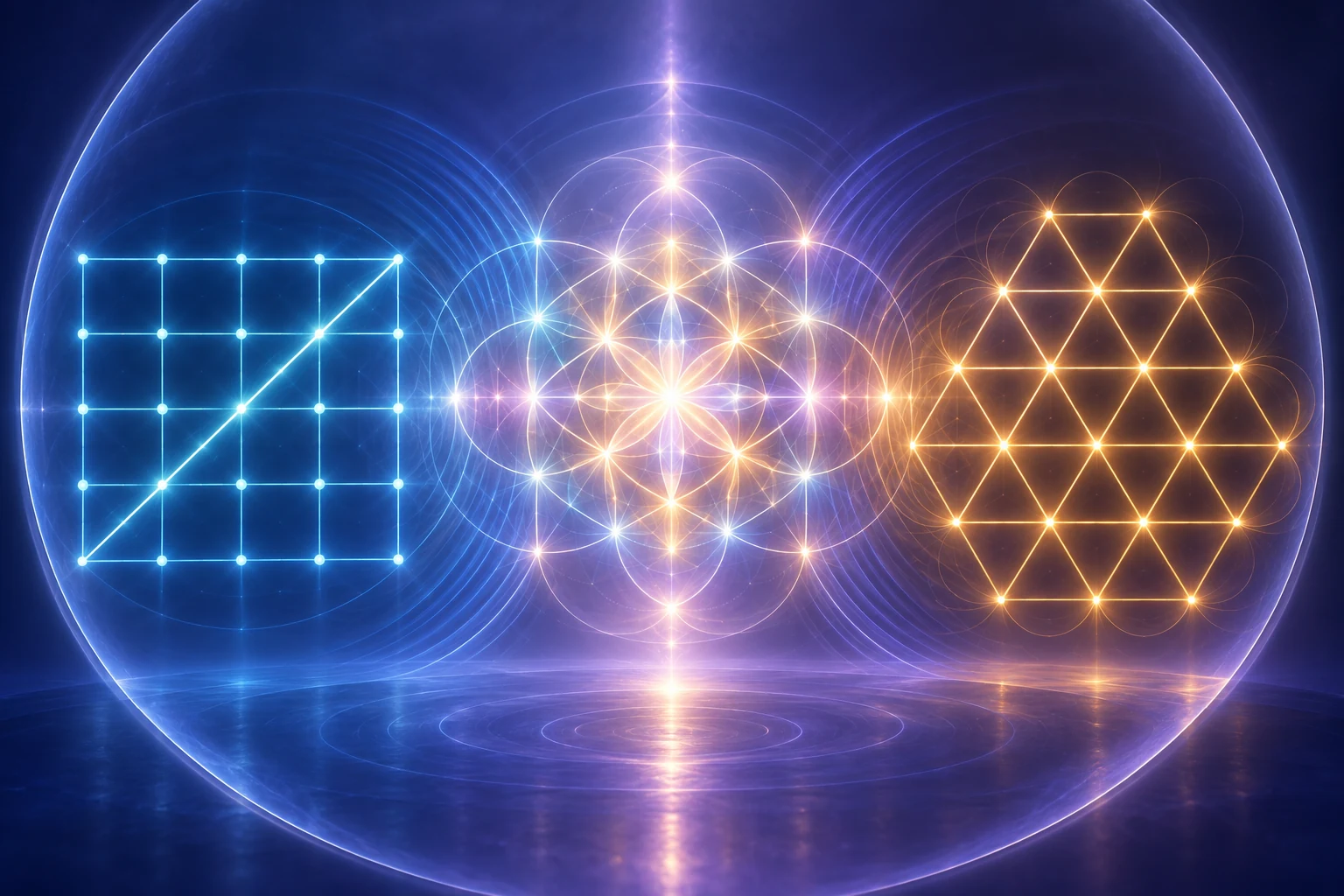
Square recurrence
The lyric clue says, “Cut across the squares and everything doubles.” For now, doubling is a source phrase awaiting a precise geometric definition and measurement.
Triangular recurrence
The companion clue associates close-packed floors with three and a third-shell return. That is a proposed counting rule to reconstruct, not yet a demonstrated property of every close-packed lattice.
What could “chamber” mean?
The word is useful precisely because its physical meaning has not been fixed. Four interpretations can be kept separate and tested one at a time.
Projection
An orientation where a pattern locks
A three-dimensional arrangement can produce crossings, apparent doubling, and diagonal relationships when projected into a plane. “Turn the key” may describe finding an orientation where hidden symmetry becomes visible.
Phase
A coherence condition
Two paths can cross without reinforcing. A stronger model would ask whether equivalent paths arrive with a defined phase relationship. In this reading, the chamber is a condition of coherence rather than a container.
Chirality
A test of reflection versus rotation
Rotation preserves handedness; reflection reverses it. If a traversal appears to invert a form, tracking chirality can tell us whether we are seeing a turn, a mirror operation, or a projection artifact.
“The centre—the centre was a label.”
The center may identify a relationship among approaching paths, not a single privileged object. If equivalent nodes can host the same relationship, the chamber could be instantiated in more than one place.
A source trail we can keep honest
The idea arrived through a mixture of mathematics, earlier site themes, and four excursion songs. Those sources do different jobs and should not be treated as the same kind of evidence.
Ways to make the idea answer back
A useful working hypothesis needs a path toward correction. These are the first modest tests the page proposes.
- Reconstruct the song sequence. Place all four excursion songs in order and record the geometry, boundary, transformation, and recurrence described in each— including contradictions and absences.
- Define the counts. Draw explicit square and triangular lattices. State exactly what counts as a step, shell, site, return, and doubling before counting anything.
- Rotate and project. Build a small digital or physical model and compare multiple views. Record which patterns are genuine adjacencies and which appear only in projection.
- Track handedness. Mark a chiral path through rotations, reflections, and crossings so an apparent inversion can be classified rather than described by impression.
- Add phase only after geometry. If path lengths can be defined, compare arrival phases under stated wavelengths. Look for both reinforcement and cancellation.
- Name a failure condition. If the two- and three-step recurrences cannot be defined consistently, or the six-count disappears under equivalent orientations, narrow or discard the proposed crossing.