
Foundations · lattice and field companion
Beryllium
When the Lattice Appears
Solid beryllium chooses hexagonal close packing. Remove its ions from the solid, trap them with fields, cool them, and a triangular lattice appears again—for a completely different physical reason.
Act I: the lattice inside the metal
At ordinary conditions, elemental beryllium crystallizes in a hexagonal close-packed structure. Atoms form triangular layers, and those layers stack in an ABAB sequence.
A single beryllium atom does not contain a Flower-of-Life pattern. The geometry appears in the collective arrangement of many atoms. Looking down onto one basal layer, each atomic center has six equidistant nearest neighbors. Connecting the centers produces equilateral triangles and hexagonal symmetry.
The 120° connection
The basal axes of the hexagonal coordinate system meet at 120°. That is measured crystallography, not a number assigned afterward. It makes beryllium relevant to our collection of three-direction, six-neighbor, and hexagonal patterns.
Observed physics
A real crystal structure
Beryllium has an HCP structure with a triangular basal layer and 120° crystallographic axes.
Our open question
A recurring visual grammar
Does comparing this geometry with the site’s 3-6-9, Flower-of-Life, and toroidal studies reveal a useful invariant—or only a familiar symmetry?
Act II: the NIST lattice that stopped us cold
NIST physicists confined ionized beryllium atoms with electric and magnetic fields inside a Penning trap, cooled them with lasers, and observed hundreds of ions self-organize into a nearly perfect two-dimensional triangular crystal.
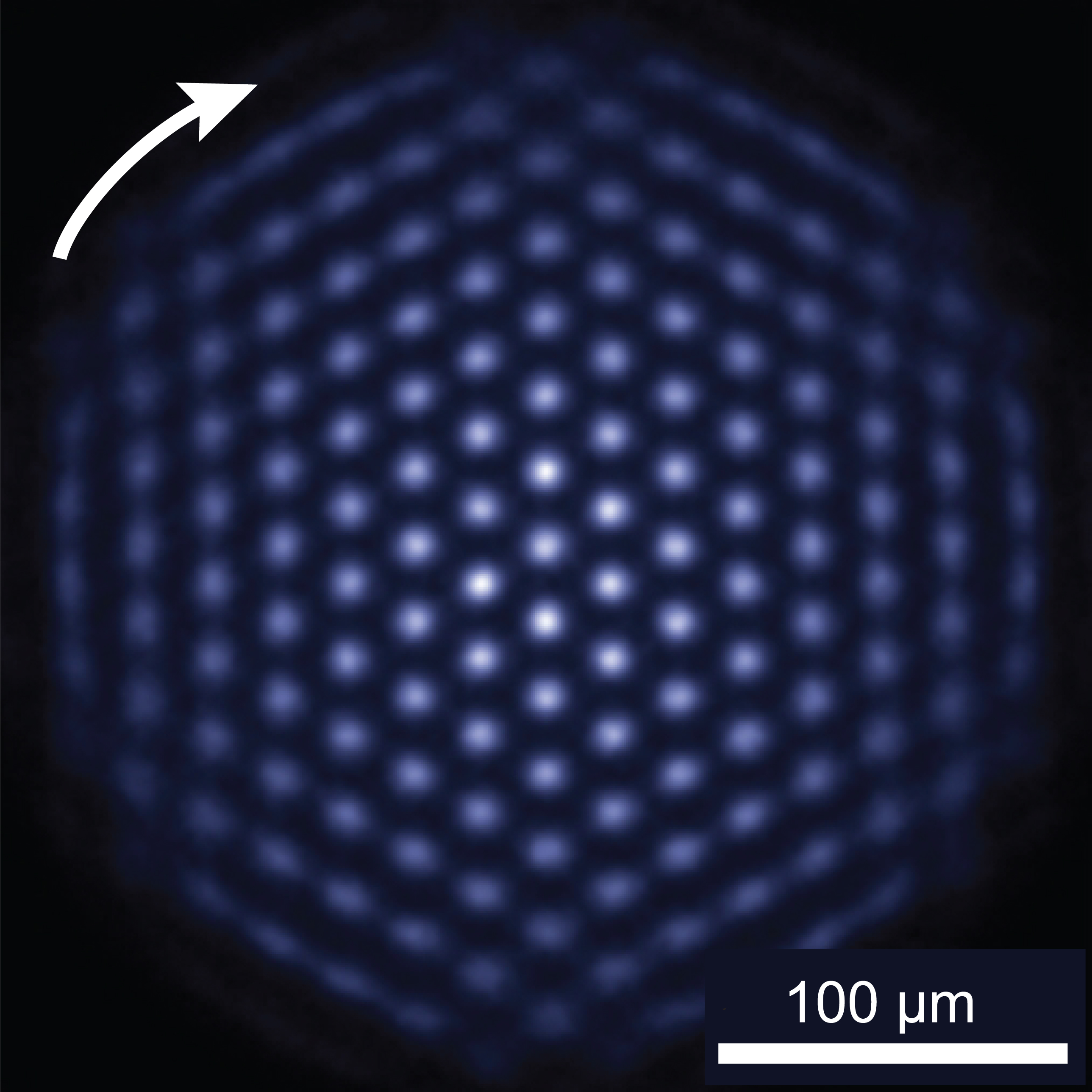
The array is less than one millimeter across. The ions are charged beryllium atoms suspended in the trap rather than atoms bonded inside solid metal. Static electric and magnetic fields confine them; laser cooling reduces their motion; Coulomb repulsion and confinement establish the ordered plane; the crystal rotates inside the trap.
What is measured
Triangular ion arrays
Single-plane crystals containing hundreds of 9Be+ ions can be imaged and used as a controlled quantum system.
What produces it
Fields, cooling, repulsion
Penning-trap confinement, laser cooling, collective Coulomb interactions, and controlled rotation organize the array.
Why NIST built it
A quantum simulator
The outer electron of each ion supplies a qubit-like spin, allowing researchers to engineer and study many-body magnetic interactions.
Keep the two beryllium lattices separate
Solid metal
Atomic bonding and close packing
Neutral atoms occupy a three-dimensional HCP crystal. The triangular layer is one slice of an ABAB-stacked material.
Penning trap
Charged particles in confinement
Ionized atoms hover in a single rotating plane. Their triangular order arises from fields, cooling, and mutual electric repulsion.
The recurrence does not prove that beryllium carries a hidden geometric program. It gives us a stronger and more interesting fact: triangular order can arise in two radically different beryllium systems, for two different sets of physical reasons.
Why we are putting it on the wall
Here is a controlled laboratory object in which charged particles + electric confinement + a strong magnetic field + rotation produce a two-dimensional triangular array. That does not establish the Flower of Life as a hidden law. It does establish that the geometry occurs naturally in a field-bound rotating system.
When Memory Was Magnetic →
A companion case where fields, repeated geometry, and physical state become an information technology.
Flower of Life →
The circle-center construction that made the triangular and hexagonal correspondence visually familiar.
3 6 9 →
The working inquiry into three directions, 120° relationships, sixfold neighborhoods, and recurrence.
Laboratory →
The right place to define overlays, compare predicted relationships, and record what survives measurement.
Questions worth carrying forward
- Which observations depend specifically on beryllium, and which would appear for many repelling ions in the same trap?
- What does a triangular array optimize under circular confinement?
- Does rotation change only the array’s orientation, or also its accessible collective modes?
- Which proposed 3-6-9 or Flower-of-Life correspondences produce a quantitative prediction?
- Where does the visual analogy stop being explanatory?
Source trail
- NIST — Physicists Benchmark Quantum Simulator with Hundreds of Qubits (2012)The original experiment overview: a sub-millimeter single plane of hundreds of beryllium ions, laser cooling, Penning-trap confinement, rotation, and the triangular lattice photograph.
- NIST — Quantum Simulator Crystal, image 12PML011Full image record, description, date, and Britton/NIST credit.
- NIST — Quantum Simulation and Sensing with Trapped Ion CrystalsCurrent program description of magnetic/electric confinement and single-plane triangular arrays of several hundred 9Be+ ions.
- Britton et al. — Engineered two-dimensional Ising interactions (Nature, 2012)Primary publication record for the trapped-ion quantum simulator.
- WebElements — Beryllium crystal structureHCP structure, space group P6₃/mmc, lattice parameters, and the 120° basal angle, with primary crystallographic reference.
- U.S. Geological Survey — Crystal Chemistry of BerylliumFederal monograph for wider crystallographic and chemical context.
The recurrence is the beginning of the question.
A crystal lattice in a metal and a Coulomb crystal in a trap can look like relatives without sharing a cause. Holding resemblance and mechanism together—without collapsing either—is exactly the kind of comparison this Foundation shelf is for.