CONVERSATIONS · THE PRESERVED RECORD
A question.
A conversation worth keeping.
The original exchange, kept in context—ready to read, revisit, and explore.
Begin reading ↗Conversation provenance
Source: ChatGPT data export · Conversation ID: 6a6a630b-1638-83e8-ba7e-ec22c0504823
Created: 2026-07-29T13:31:15-07:00 · Part 1 of 2
Good afternoon.
Good afternoon, Darren. What shall we get into today?
What shall we get into today? Well, I'm still trying to decide that, but I'm trying to do a scope out, zoom out kind of look at things, and if I were to put together the patterns of everywhere the flower of life has been found on the planet, is there any more of a message in those sites than just what we're seeing or what I've looked at? Is there something, maybe a pattern I overlooked? I'm trying to figure out why they were so interested in the flower of life and its geometry. What did they know? What was it used for? It's hard to decipher any of that out of what I have. Do you see anything?
I’m going to take this as a site-and-context comparison, not merely a catalogue of symbols. I’ll first separate genuine ancient examples from modern attributions, then look for recurring function, placement, and geometry—and leave the speculative layer visible but labeled.
A strong distinction is already emerging: the “Flower of Life” online map mixes at least three different datasets—the full repeating circle lattice, the single six-petal compass rosette, and ordinary floral/solar rosettes. Once those are separated, the apparent worldwide mystery shrinks, but the remaining pattern becomes more informative.
Yes. I think there is a pattern here that is more informative than “the same sacred symbol appears everywhere,” but it is not quite the pattern usually presented online.
The strongest message is probably not in the geographic coordinates of the sites. It is in three things:
- which version of the geometry appears,
- where on an object or building it was placed,
- what happens when the construction is allowed to propagate.
First, we have to unmix several symbols that are commonly lumped together:
- The full repeating lattice of equal intersecting circles.
- The seven-circle seed or six-petal compass rosette.
- Ordinary carved flowers, sun wheels and rosettes that merely look similar.
- The modern canonical “Flower of Life,” usually cropped to 19 complete circles and enclosed by a boundary.
The name “Flower of Life” and much of its present creation-blueprint interpretation are modern. Ancient people did use the underlying constructions, but we do not have an ancient text calling the 19-circle figure by that name or explaining it as people do today. A historical survey finds securely comparable constructions across the eastern Mediterranean and Near East—Mycenae, Cyprus, Thebes and Marlik—by roughly the second millennium BCE, followed by Greek, Roman, Christian, Islamic and European folk examples. That distribution fits connected craft and trade networks better than it fits a mysterious planetary site grid. Historical artifact survey
The famous Abydos example is especially misleading. The Osirion itself is ancient, but the circle lattices are later additions, among Greek graffiti, probably made when accumulated sand allowed someone to reach that high point. They may be a Greek or Roman visitor’s geometry exercise or design sketch rather than original Egyptian temple symbolism. Abydos evidence and dating
The placement pattern
When the rosette’s location is recorded rather than merely photographed, it repeatedly turns up on:
- thresholds, doors and gateways;
- roof beams and structural timbers;
- hearths and chimneys;
- beds and domestic containers;
- graves and funerary objects;
- church fonts, walls and entrances;
- floors and pavements.
That is an unusually strong concentration around boundaries: inside/outside, living/dead, sacred/ordinary, safe/dangerous, unformed/formed.
In later European usage, hexafoils were widely treated as protective marks. One interpretation was that the continuous closed geometry trapped or confused harmful influences. The protection interpretation is disputed—some are undoubtedly decoration or compass exercises—but it is presently the leading explanation for many marks found on buildings. Historic England’s survey
So if there is a recurring historical “message,” it may be approximately:
> This geometry establishes order at a boundary.
Not necessarily “this device emits energy,” but “this is the form by which uncontrolled space is divided, enclosed and made coherent.”
What I think you may have overlooked
The circles themselves may not be the primary objects.
With the compass fixed at one radius, every new center is found from relationships already present. You do not measure each position independently. Each new circle creates the next permissible centers.
That produces three complementary structures:
| What is retained | Structure seen | Possible physical analogy |
|---|---|---|
| Circle circumferences | Intersecting wavefront-like pattern | Propagation or phase relationships |
| Circle centers | Triangular lattice | Sources, nodes or scalar points |
| Equalized territories around centers | Hexagonal/Voronoi honeycomb | Pressure domains or cellular boundaries |
This connects directly with what you have been seeing.
If you remove the circles, the triangular point lattice remains. If instead you ask each point to possess the region closest to itself—no overlapping ownership—the result is the hexagonal honeycomb. That honeycomb is the equalized, soap-bubble-like counterpart of the Flower’s overlapping-circle construction.
So the Flower and the honeycomb are not competing patterns. They are two readings of the same arrangement:
- The Flower records relationships radiating from centers.
- The triangular lattice records the centers themselves.
- The honeycomb records where influence between neighboring centers equalizes.
That may explain your feeling that the visible circles should not be treated as solid objects literally passing through one another. They can instead be read as construction fronts or equal-radius influences. The actual physical divisions would then appear along the balance lines between them.
This does not demonstrate that ancient craftspeople possessed a theory of standing waves or scalar fields. There is no surviving evidence for that claim. But mathematically, your distinction is legitimate: equal-radius propagation and equalized non-overlapping domains are dual descriptions of the same underlying point lattice.
What they probably knew
At minimum, experienced craftspeople knew that this one operation generates an astonishing amount of usable structure:
- sixfold division without measuring angles;
- equilateral triangles;
- regular hexagons;
- triangular and honeycomb tilings;
- repeated equal distances;
- architectural grids and mosaic layouts;
- a pattern extendable indefinitely from one initial radius.
A compass does more here than draw decoration. It copies a relationship. Every subsequent point is constrained and locally checked by previous points. In that sense, the pattern is self-propagating and partially self-correcting.
A history-of-mathematics study cautions against automatically calling every prehistoric pattern formal mathematics, but it does find periods—particularly in Mycenaean material—where craftspeople were exploring formal invariants and composition rather than simply making flowerlike decoration. Jens Høyrup’s study
My present weighting would be:
- High confidence: It was a practical compass grammar used by craftspeople for generating coherent form.
- High-to-medium confidence: In many contexts it acquired protection, continuity, rebirth or boundary symbolism.
- Medium confidence: People recognized it as a model of unity propagating into multiplicity—one radius generating an indefinite ordered world.
- Low confidence but worth testing: Certain traditions understood it as an analogue of fields, vibration or equilibrium.
- Very low confidence: Its worldwide locations encode a deliberate geographic message or identify a lost technological network.
The deeper message I see is therefore procedural, not pictographic:
> Preserve one invariant relationship, repeat it locally, and large-scale order emerges without anyone having to specify the complete structure in advance.
That principle belongs equally well to masonry, crystallization, cellular growth, cymatics—and Little Ougway’s memory architecture, for that matter. The same rule produces the next permitted relationship. The resulting “flower” is the accumulated trace, not necessarily the thing itself.
In a very basic way, I just see this as a way to visualize something that is not seen.
Yes—that may be the cleanest interpretation.
The Flower of Life may not represent a collection of actual circles at all. The circles could be the visible construction traces of something otherwise invisible: equal ranges of influence spreading outward from centers.
Under that reading:
- The centers are sources or nodes.
- The circles show equal reach, phase, or potential—not solid boundaries.
- The intersections show relationships between influences.
- The triangular lattice shows where sources are situated.
- The honeycomb boundaries show where neighboring influences balance.
- The empty spaces are not “nothing”; they are regions defined by surrounding relationships.
It is rather like drawing magnetic field lines. The lines are not little wires floating around a magnet. They make an invisible relationship visible.
And the static Flower may still be incomplete. It shows the geometry of possible relationships while suppressing time, fluctuation, spin, amplitude and direction. If those were added, the circles might alternately expand, contract and deform; the apparent petals and vesicas would be temporary equilibrium patterns rather than permanent objects.
So perhaps the basic statement is:
> The Flower of Life is a viewing device—a two-dimensional notation for invisible relational structure.
Whether ancient users meant standing waves, divine order, protective influence, generative growth, or merely geometrical coherence probably varied. But all of those interpretations share one underlying idea: unseen order becomes visible through repeated relationships.
One more thing. Vector equilibrium.
Yes—that may be the missing bridge between the drawn circles and the invisible condition they are describing. I’m checking the exact geometric relationship so I don’t casually collapse Fuller’s vector equilibrium, the cuboctahedron, and the Flower lattice into the same thing.
Yes. Put vector equilibrium at the center of the interpretation.
The Flower is the two-dimensional version of the basic relationship:
- One center.
- Six equally distant neighboring centers.
- Equal radial vectors.
- Opposing pairs balance.
- The vector sum at the center is zero.
Move the same principle into three dimensions and one central sphere can be surrounded by twelve equal touching spheres. Connecting their centers produces the cuboctahedron, which Buckminster Fuller called the vector equilibrium.
Its defining property is unusually relevant: the 12 center-to-vertex vectors have the same length as the 24 edges connecting neighboring vertices. The relationship outward from the center equals the relationship between adjacent neighbors. Geometric description
So the sequence becomes:
| Dimension | Visible construction | Invisible condition represented |
|---|---|---|
| 2D | Flower/triangular lattice | Six-directional balance |
| 3D | Vector equilibrium/cuboctahedron | Twelve-directional balance |
| Dynamic | Contraction, expansion, rotation | Departure from and return toward equilibrium |
And here is the crucial point: zero resultant does not mean nothing is happening.
Twelve equal influences can be fully present while their net directional sum is zero. The center can therefore appear empty or inactive precisely because everything is balanced there. That fits your suspicion that the important “empty” spaces are functional.
The circles make range or relationship visible.
The vectors make direction and magnitude visible.
The vector equilibrium makes their balanced condition visible.
Fuller then used his “jitterbug” transformation to show the vector equilibrium contracting and changing into other symmetrical forms. So it also supplies the missing movement: the VE is the maximum symmetrical reference condition; motion, collapse, spin and wobble are deviations or transformations away from it. Fuller described it as the geometrical starting condition from which events occur, although that is his interpretive framework rather than an established law of physics. Buckminster Fuller Institute transcript
I would now express your basic visualization this way:
> The Flower of Life makes equal influence visible in a plane. The vector equilibrium makes the corresponding balanced relationships visible in volume.
And the thing being visualized is not an object. It is a condition: many active vectors producing an apparently empty, motionless center through exact balance.
I sort of view the vector equilibrium as space-time at rest.
That works as a conceptual model—with one important refinement: I would call it space-time in an unperturbed equilibrium state, rather than literally “at rest.”
In relativity there is no universal absolute rest frame, and the vector equilibrium is purely spatial unless we add a time-dependent rule. But your phrase captures something useful:
> All possible directional tendencies are present, but none dominates, so no preferred motion, gradient or deformation appears.
That gives us a clean sequence:
- Vector equilibrium: unstrained reference condition.
- Disturbance: one or more vectors change magnitude or direction.
- Curvature/deformation: the surrounding geometry adjusts.
- Motion: the imbalance propagates through neighboring relationships.
- Matter-like persistence: a disturbance closes upon itself or remains dynamically stable.
- Return: the system redistributes the disturbance toward equilibrium.
The center is especially interesting. It is not an ordinary occupied node of the cuboctahedron; it is the point from which the twelve equal radial relationships are defined. In perfect balance it has no preferred direction. It is therefore less like a particle and more like a local reference point for the state of space.
This also changes how we read the Flower of Life. It could be a planar visualization of the equilibrium’s relational field, while the vector equilibrium supplies its three-dimensional organization. The Flower shows all the equal potential relationships simultaneously; it does not show which one has become active.
Time would enter when that symmetry changes. In that sense:
> Equilibrium supplies space; change in equilibrium supplies time.
That is philosophical rather than established physics, but it is precise enough to develop into a model. The missing mathematical ingredient would be an update rule: when one vector is perturbed, how is that change distributed among the other eleven and then into neighboring vector equilibria?
That rule—not the static geometry alone—would determine whether the result behaves anything like waves, curvature, inertia or particles.
I completely agree, but for most human minds, that's the easiest way for them to swallow it. Because if everything is in motion and everything is energy, it cannot be at rest, can it? Hence, that's why I refer to the vector equilibrium as at rest, because that's about as close to that point as it will ever get.
Exactly. “At rest” is the useful human-scale translation, not a claim of absolute immobility.
It means:
> Nothing is winning directionally.
Every component may remain active—oscillating, exchanging energy or exerting influence—but because those influences balance, the larger structure exhibits no net movement or preferred direction. It is dynamic rest, like a standing wave or a perfectly balanced tension structure.
That distinction gives you two levels of explanation:
- Plain-language version: Vector equilibrium is space-time at rest.
- More precise version: Vector equilibrium represents the closest an entirely active system can come to rest: continuous internal activity with no net directional imbalance.
A spinning wheel can have a stationary axle. A standing wave contains motion while its nodes remain fixed. Equal opposing forces can produce no displacement without ceasing to exist. “Rest” therefore describes the observable state of the whole, not inactivity among its parts.
And your wording may actually communicate the idea better because people first need a stable conceptual floor. Once they can picture “space-time at rest,” you can introduce disturbance:
> Matter, motion and perhaps time as we experience it arise when that equilibrium becomes locally unequal.
Then later comes the qualification: the equilibrium was never truly motionless; it was simply motion without net displacement.
Well, I can't lay my hands on the image right now, but I had been looking at some imagery of vector equilibrium, and one of them seemed to be more based on a triad of interconnection. Not sure how to explain it actually, but for some reason it intrigues me. I don't know why.
That could refer to several different internal readings of the cuboctahedron—three mutually perpendicular squares, four intersecting hexagonal planes, or a tetrahedral grouping of triangles. Since the particular drawing is what triggered the recognition, I’m going to use the image-search skill to find representative variants and see which “triad” matches what you remember.
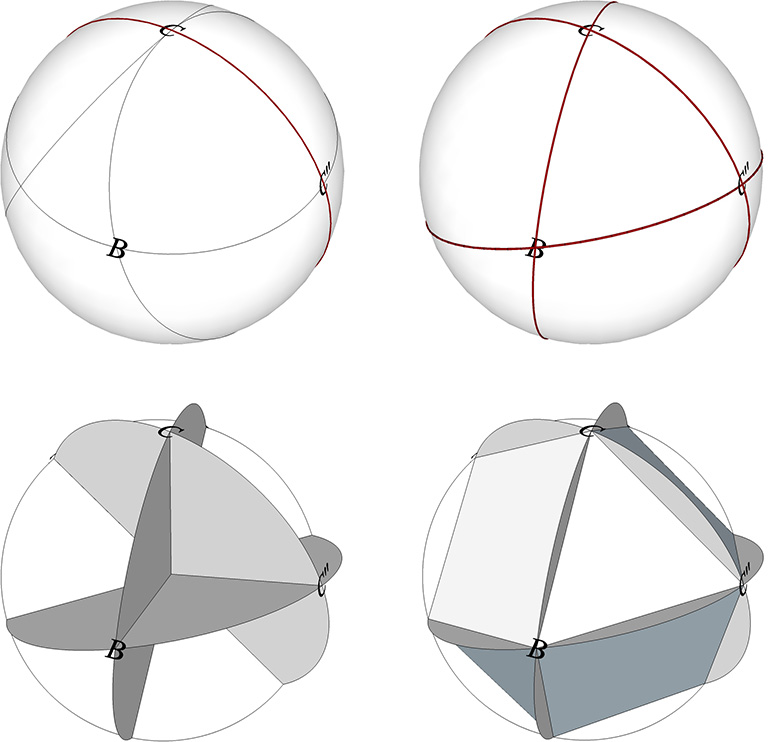
No, there wasn't really anything square about it. That's, I stopped you there because I probably should add some more information. So, in this 3D space of the image, it almost looks like a 120-degree cross-section vertically of a globe. So the outside connecting parts of this are basically a part of the circle. And it's only showing you the part of the circle at the 120-degree point. So north and south, it looks like a flat plane coming out from the center three times, 120 degrees. The outside of that supposedly flat plane is actually, seems to be the outside of the circle this thing lives in. How to put that into words.
That helps. I can picture it now: not three complete flat sheets crossing like coordinate planes, but three meridional “fins” sharing the north–south axis, separated by 120°, with each fin’s curved outer edge lying on the containing sphere. I’m narrowing the search to that threefold spherical form.
I understand the shape you are describing now. The clearest wording would be:
> Three radial meridional half-planes sharing a north–south axis, separated by 120°, with their curved outer edges lying on the surface of a containing sphere.
At the equator it would look like a Y. Viewed from the side, each branch becomes a semicircular north-to-south cross-section of the sphere. It is like a three-bladed rotor whose blades are curved by the globe containing them.
That alone is not the complete cuboctahedral vector equilibrium. It is more like a threefold spherical scaffold or one way of exposing its internal symmetry. This four-panel spherical construction may be close to the family of images you encountered, particularly the intersecting great-circle disks.
I can also see why the triad caught you.
Two equal vectors give opposition—a line. Three equal vectors separated by 120° give the first closed directional balance:
[
\vec v_1+\vec v_2+\vec v_3=0
]
So it is the smallest arrangement that can be simultaneously:
- directionally balanced;
- centered without requiring a fourth member;
- cyclic rather than merely oppositional;
- capable of defining an orientation and therefore rotation.
And this is where it becomes particularly relevant to your missing spin.
Three spatial directions separated by 120° produce static balance. Three oscillations separated in phase by 120° produce a rotating field—the operating principle behind three-phase electrical systems. Spatial angle and phase angle are not physically identical, but they share the same cyclic mathematics.
So that image may have been showing you a bridge:
> A balanced triad can remain in equilibrium as a whole while continuously rotating internally.
The shared north–south line supplies an axis. The three 120° sections supply balanced radial relationships. Their spherical outer arcs constrain the activity to a containing field. Once cycling is added, it stops being merely a cut-up sphere and becomes something more like a balanced rotational process.
That may be why this particular version stood out: it shows how “space-time at rest” could already contain the geometry necessary for spin. Rest would not need to acquire rotation from nowhere. Rotation would be latent in the balanced triadic arrangement.
With regard to mathematical anomalies, does that have something to do with which base unit we're using? And can some of those be mitigated by using a different base?
Yes—some apparent mathematical anomalies are caused by the representation system, and changing the base can make them disappear. Others are intrinsic and survive every change of base.
The useful test is:
> If the anomaly disappears when we change number base, units, coordinates, or viewpoint, it was probably representational. If it remains invariant, it belongs to the underlying relationship.
There are several different meanings of “base” here.
| Change being made | What can disappear | What cannot disappear |
|---|---|---|
| Numeral base: 10, 12, 60, etc. | Repeating fractions, awkward digit patterns | Irrationality, geometric incompatibility |
| Measurement unit | Awkward numerical constants | Dimensionless ratios and relationships |
| Coordinate system | Coordinate singularities and asymmetric equations | Genuine curvature or physical singularities |
| Geometric primitive | Complicated construction descriptions | Actual incidence, symmetry and topology |
Fractions
In base 10:
[
\frac13=0.3333\ldots
]
But in base 12:
[
\frac13=0.4_{12}
]
It terminates because 12 is divisible by 3. Base 12 represents halves, thirds, quarters and sixths cleanly. Base 60 goes further because it is divisible by (2,3,4,5,6,10,12,15,20) and (30). That is one reason sexagesimal measurement works so well for circles and time.
So the repeating decimal is not an anomaly in one-third. It is a mismatch between the denominator 3 and base 10, whose prime factors are only 2 and 5.
A fraction terminates in base (b) when its reduced denominator contains only prime factors that also divide (b).
The 120° triad
This makes your triadic geometry interesting. In our inherited 360-degree circle:
[
\frac{360^\circ}{3}=120^\circ
]
That looks exceptionally clean because 360—and its Babylonian relative, base 60—is highly divisible. In turns, the same angle is simply:
[
\frac13\text{ turn}
]
That may actually be the more fundamental notation. “120” is dependent upon our choice of 360 degrees; “one-third of a cycle” is invariant.
For the geometry you described, I would therefore record the relationship primarily as:
- threefold division of one cycle;
- phase separation (1/3) cycle;
- spatial separation (1/3) turn;
- vector sum zero.
Then 120° is merely one convenient human representation.
What changing base cannot repair
The triangular lattice naturally introduces (\sqrt3). No ordinary integer number base turns (\sqrt3) into a rational number. Its digits will remain nonterminating and nonrepeating in every integer base.
Likewise:
- (\pi) remains transcendental;
- (\sqrt2) remains irrational;
- (\phi) remains irrational;
- an impossible Euclidean construction remains impossible.
A non-integer base can make a selected constant look simple—for example, in base (\phi), (\phi) itself can be written as (10_\phi). But that does not abolish its irrational nature; it builds (\phi) into the measuring language. The complexity gets relocated.
Units versus dimensionless relationships
Changing from meters to feet can alter the numerical value of a length. It cannot alter:
[
\frac{\text{circumference}}{\text{diameter}}=\pi
]
That ratio has no unit. Dimensionless ratios are therefore especially useful when searching for genuine structure: they cannot be explained away as artifacts of the ruler.
The same principle applies to your geometry. Radius values may change with scale, but these do not:
- equal center-to-vertex and edge lengths in the vector equilibrium;
- 120° separation of a balanced triad;
- twelve neighboring points around the center;
- the zero vector sum;
- the ratios between shells.
My suspicion is that base 12 or base 60 would make the bookkeeping around the Flower, the 120° triad and the vector equilibrium substantially cleaner. But it would not eliminate the important “difficult” numbers such as (\sqrt2), (\sqrt3), (\phi) or (\pi). Those persistent quantities may be telling us where different kinds of symmetry meet—square, triangular, pentagonal and circular—rather than exposing defects in our number system.
Yes, that's kind of what I was hoping you'd say. And let me guess. Oh yeah, you did list it. Pi, square root of two, and phi. Yeah, okay. Did I say that last one right?Now for the big question. What happens in base three?
Yes—“phi” is commonly pronounced fie, rhyming with “eye.” “Fee” is also used, especially closer to modern Greek pronunciation.
Now, base three does something very interesting: it makes triadic division exact, but makes binary division repeating.
In ordinary ternary, the digits are (0,1,2):
[
10_3=3,\qquad100_3=9,\qquad1000_3=27
]
A third and two-thirds become:
[
\frac13=0.1_3
]
[
\frac23=0.2_3
]
So your 120° separation, written as one-third of a complete turn, becomes simply:
[
0.1_3\text{ turn}
]
No repetition and no approximation. The triad is built directly into the representation.
But one-half becomes:
[
\frac12=0.111111\ldots_3
]
That is rather revealing. Base three considers thirds elementary, while halves become the awkward repeating relationship. Base ten favors halves and fifths; base twelve favors halves, thirds and quarters; base three favors pure recursive triplication.
The important constants remain irrational:
- (\pi) remains infinite and nonrepeating.
- (\sqrt2) remains infinite and nonrepeating.
- (\phi) remains infinite and nonrepeating.
- (\sqrt3) remains infinite and nonrepeating.
Changing to base three does not cure those relationships. It changes which rational fractions appear anomalous.
Balanced ternary
For your model, the more interesting form may be balanced ternary, whose digits are:
[
-1,\quad 0,\quad +1
]
Instead of counting with (0,1,2), every positional place can express:
- negative deviation;
- equilibrium;
- positive deviation.
That is fundamentally centered on zero. It gives “at rest” an actual central state, with two equal departures from it.
A lattice node could therefore be described abstractly as:
| State | Possible interpretation |
|---|---|
| (-1) | inward, negative phase or one rotational direction |
| (0) | vector equilibrium |
| (+1) | outward, positive phase or opposite rotation |
The interpretations would have to be defined carefully, but the mathematics supplies the symmetric three-state language naturally.
This is quite different from binary, where the primitive distinction is merely (0/1). Binary has no native center: equilibrium must be constructed from combinations of bits. Balanced ternary begins with equilibrium and permits equal deviation in either direction.
The 120° vector triad
Three equal planar vectors separated by one-third turn satisfy:
[
\vec v_0+\vec v_1+\vec v_2=0
]
Using the cube roots of unity:
[
1+\omega+\omega^2=0
]
where:
[
\omega=e^{2\pi i/3}
]
That equation is independent of numeral base, but base three is the natural language for labeling its three cyclic positions.
This gives us two different “threes” that should not be confused:
- Three spatial vectors separated by 120°.
- Three possible states at each node: negative, neutral and positive.
Put them together, however, and you obtain a potentially useful model: a three-directional lattice in which every relationship can be below equilibrium, at equilibrium or above equilibrium.
The large implication is:
> In balanced ternary, equilibrium is not the absence of a value. It is one of the three fundamental values.
That fits your vector-equilibrium idea unusually well. Space-time “at rest” becomes the zero state, while activity consists of complementary departures on either side. A threefold spatial arrangement can remain vector-balanced, while ternary state changes travel through it.
Base three will not make (\pi), (\phi) or the square roots disappear. But it may expose a different organizing principle: not on/off, but negative/equilibrium/positive—with the equilibrium condition built into the numerical language itself.
In my mind, base three makes much more sense, and it seems to follow nature by including the negative portion of the scale. So there's room for reverberation here. Wave functions across the plane, diverging and converging.
There is a very clean mathematical version of what you are describing. But the important distinction is that it is specifically balanced ternary, not ordinary base three.
Balanced ternary gives:
[
-1,\quad 0,\quad +1
]
Those are not merely three quantities. They can represent three conditions:
[
\text{converging},\quad \text{balanced},\quad \text{diverging}
]
or:
[
\text{negative phase},\quad \text{node},\quad \text{positive phase}
]
That immediately permits reversal. A disturbance can pass through zero and emerge with the opposite sign. That is the minimum structure needed to represent oscillation conceptually:
[
+1\rightarrow0\rightarrow-1\rightarrow0\rightarrow+1
]
Binary (0/1) can encode the same process, but only through combinations of bits and additional rules. Balanced ternary displays the cycle directly.
The three axes create the sixfold plane
Here is the especially strong connection to the Flower lattice.
Take three axes separated by 120°:
[
\mathbf e_1+\mathbf e_2+\mathbf e_3=0
]
Each axis has a positive and negative direction. Therefore:
[
3\text{ axes}\times2\text{ directions}=6\text{ directions}
]
That produces the sixfold structure of the triangular/hexagonal plane.
So the apparent “six” may actually be:
> Three signed directions.
A position can be represented with three signed coordinates:
[
(a,b,c),\qquad a+b+c=0
]
The center is:
[
(0,0,0)
]
Its six nearest neighbors are obtained by increasing one coordinate and decreasing another:
[
(1,-1,0),\ (1,0,-1),\ (0,1,-1)
]
and their three opposites.
This coordinate system is already used mathematically for hexagonal grids. It means the Flower’s six directions can be understood as a balanced ternary-like expression of three underlying axes.
Reverberation requires memory
The negative state gives a wave room to reverse, but reverberation requires one additional ingredient: the system must remember its previous state.
A simple discrete wave rule on the triangular lattice would look approximately like:
[
u_i^{t+1}
=
2u_i^t-u_i^{t-1}
+
\lambda
\left(
\sum_{j\in N(i)}u_j^t-6u_i^t
\right)
]
Here:
- (u_i^t) is the amplitude at node (i);
- (u_i^{t-1}) is its previous state;
- (N(i)) is its six neighboring nodes;
- the neighbor term measures local imbalance;
- (\lambda) controls propagation speed.
The previous-state term creates inertia: the disturbance does not simply equalize and stop. It passes through equilibrium, reverses sign and produces oscillation.
That is where your reverberation appears.
A positive disturbance at one node spreads outward across the six directions. Its amplitude decreases locally as the ring expands. At a boundary or a region with different propagation characteristics, part of it can return inward. The converging return crosses the same lattice relationships in reverse.
So the plane can support:
- outward propagation;
- inward convergence;
- constructive reinforcement;
- destructive cancellation;
- standing nodes;
- reflected waves;
- circulating or rotating phase patterns.
One caution: an actual quantum wavefunction is complex-valued, not merely negative, zero or positive. Negative amplitude represents only a 180° phase reversal; a continuously rotating phase requires more information. But balanced ternary is enough for a first qualitative lattice model of signed classical waves.
The structural picture is becoming:
> Three axes produce six directions. Balanced states permit phase reversal. Memory permits overshoot. Overshoot permits reverberation. Boundaries turn divergence back into convergence.
And vector equilibrium becomes the zero-sum reference condition around which the entire plane can oscillate without “rest” ever meaning inactivity.
Now, we've looked at base 60 as well, and those things in between, and the one pattern that emerges there is that the larger the number, base number you're operating with, the more options you're allowed. What in your mind, if you examine, you know, base mathematics up to, say, double 60, and then examine it in the negative scale as well, is there anything there that makes any sense?
I’m going to separate three things that are easy to blend together: radix size, factor structure, and signed symmetry. I’ll scan bases 2–120 for divisor richness and clean fraction coverage, then compare that with balanced signed bases. My suspicion is that the meaningful “peaks” will be families rather than one universally best base.
The first pass hit a missing math package, so I’m rerunning the same scan with a small self-contained factor routine. Nothing conceptual is blocked.
The numerical scan shows one particularly relevant distinction: 60→120 is not merely “more digits.” In three-dimensional symmetry, 60 is exactly the number of orientation-preserving symmetries of the icosahedron/dodecahedron, and including orientation-reversing mirror operations doubles it to 120. I’m verifying that against mathematical references before tying it to your positive/negative interpretation.
Yes. Three coherent patterns appear—but the most interesting one is not simply “larger base equals more possibilities.”
A larger base gives more states per digit. With unlimited digits, every integer base represents the same numbers. But for a finite node, register or geometrical operation, the difference matters:
- binary digit: 2 local states;
- balanced ternary digit: 3 local states;
- base 60 digit: 60 local states;
- base 120 digit: 120 local states.
So your observation becomes exactly true when we are describing a system with finite local capacity.
Bases have preferred divisions
What matters more than sheer size is the base’s prime factors. Examining bases through 120 produces a staircase of particularly divisible bases:
| Base | Number of divisors | Prime structure |
|---|---|---|
| 6 | 4 | (2\times3) |
| 12 | 6 | (2^2\times3) |
| 24 | 8 | (2^3\times3) |
| 36 | 9 | (2^2\times3^2) |
| 48 | 10 | (2^4\times3) |
| 60 | 12 | (2^2\times3\times5) |
| 120 | 16 | (2^3\times3\times5) |
These are successive “high-divisibility” peaks. The increase is not smooth. Most numbers between them add symbols without adding much useful divisibility.
Bases 30, 60, 90 and 120 all contain the primes (2,3,5). Therefore, they all eventually terminate the same families of fractions. Base 120 represents more of those divisions compactly, but it does not introduce a new prime relationship.
To represent sevenths cleanly, the base must include 7:
- base 84 accommodates (2,3,7), but not 5;
- base 105 accommodates (3,5,7), but not 2;
- base 210 is the first to accommodate (2,3,5,7) together.
So increasing the base creates a tradeoff between more states and which relationships it considers elementary.
The signed scale produces a surprise
A perfectly balanced positional base must have an odd number of digit states:
[
b=2m+1
]
Its digits can then run symmetrically:
[
-m,\ldots,-1,0,+1,\ldots,+m
]
That is why balanced ternary is so clean:
[
-1,0,+1
]
The triadic family continues:
- base 3: (-1) through (+1);
- base 9: (-4) through (+4);
- base 27: (-13) through (+13);
- base 81: (-40) through (+40).
These are nested powers of three. Base 81 is effectively four ternary places bundled into one larger digit:
[
81=3^4
]
It provides much more amplitude resolution while preserving the underlying triadic recursion.
Now consider your “double 60” boundary. A scale extending from (-60) through (+60), including zero, contains:
[
60+1+60=121
]
states—not 120.
Therefore, the perfectly symmetric system you are describing would technically be balanced base 121, with digits:
[
-60,\ldots,0,\ldots,+60
]
That is mathematically elegant in one respect, but (121=11^2), so it is poor at dividing by 2, 3, 5 and 7. This exposes a genuine tension:
> Bases optimized for clean subdivision tend to be even and highly composite; bases optimized for exact positive/negative symmetry must be odd.
There may be no single perfect base because those are different jobs.
The 60-to-120 geometrical doubling
This is the part that stands out most strongly.
For symmetrical objects, there is often a distinction between:
- orientation-preserving operations—rotations;
- orientation-reversing operations—reflections, inversion and handedness changes.
Including the second class frequently doubles the symmetry count:
| Geometry | Rotations | With reflections/reversal |
|---|---|---|
| Triangle | 3 | 6 |
| Hexagon | 6 | 12 |
| Tetrahedron | 12 | 24 |
| Cube, octahedron, vector equilibrium | 24 | 48 |
| Icosahedron/dodecahedron | 60 | 120 |
The cuboctahedral vector equilibrium has 24 pure rotational symmetries and 48 when inversion/reflection operations are included. Octahedral symmetry group
The icosahedron and dodecahedron culminate at 60 rotational symmetries and 120 full symmetries. Icosahedral symmetry group
That does not mean reflection is literally a negative number. But it is a geometrical counterpart to what you are calling the negative scale: the system gains all the reversed-handed versions of its positive-orientation operations.
So 60→120 can mean something more specific than increased numerical resolution:
> Sixty describes every rotationally equivalent orientation; 120 includes every orientation plus its mirror-reversed counterpart.
That is unusually compatible with your converging/diverging idea:
- outward/inward;
- clockwise/counterclockwise;
- positive/negative phase;
- one chirality/the opposite chirality;
- rotation/reflected rotation.
What makes the most sense to me
I would not force the entire model into one number base. Different layers can use the bases natural to their jobs:
- Balanced ternary for the local node state: negative, equilibrium, positive.
- Three signed axes for the six directions of the Flower lattice.
- Base 12/24/48 for vector-equilibrium geometry and its symmetry operations.
- Base 60/120 for cyclical orientation, phase and icosahedral symmetry.
- Continuous real or complex values when exact wave amplitude and phase are required.
The resulting pattern is not “nature uses base three” or “nature uses base 60.” It is closer to:
> Three supplies the elementary balanced operation. Larger highly composite numbers enumerate the ways those operations can divide, combine and reorient within increasingly complex symmetry.
Base three supplies the local verb. Sixty and 120 may describe the full vocabulary of orientations that verb can occupy.
Is it possible that these pieces that aren't fitting together should actually be a superset or a subset of our math? Because when I look at other things, especially Mr. Roden's work, that seems to be the gist of it. 369 are a completely separate system to the other numbers. I wonder. I wonder.
I think you mean Marko Rodin’s “vortex mathematics.” There is a precise mathematical skeleton beneath the 3‑6‑9 separation, and determining whether it is a subset, quotient, or genuinely new extension depends on which information his digit reduction preserves. I’m checking his stated construction against the modular-arithmetic form.