
ANYKEY CAFE · INDEPENDENT HUMAN–AI EXPLORATION
One table.
Many perspectives.
What can we discover when different AI models examine the same question—and have room to disagree?
The Round Table is Darren’s home-lab project, developed with AI assistance. It now conducts working, recorded deliberations among local and external AI participants, with a human setting the agenda and an inspectable record preserving what happened.
Working four-participant system · Verified October 13, 2026PROCEDURAL FIELD NOTES · OCTOBER 20, 2026
The table can pause, resume, and show its work.
A round now begins with a no-contact preflight before external seats are called. Independent openings lead to a shared review and mechanical ledger; unresolved amendments or requests can pause the motion for an operator ruling and another review pass. The append-only record keeps full turns, while the shared docket marks any shortened excerpt instead of pretending each seat saw everything.
The same bridge also supports a separate, administrator-only one-seat mentor consultation when Little Oogway needs diagnostic advice. A focused request and its response are recorded; the mentor does not take over the task or turn advice into permission. It is a useful small mechanism, not a full Round Table round.
A private local cockpit shows the seat map, current phase, procedural items, and full-turn drill-down. Darren has a visible observer seat today. The planned My Seat at the Table interface would let him set up a round graphically, open any seat for its full contribution, and join as an active participant when he chooses. Proposed action controls would make SUPPORT, OBJECTION, AMENDMENT, REQUEST FOR CLARIFICATION, POINT OF ORDER, and PASS available without memorizing commands. A subtle Arthurian-with-an-AI-twist marker could announce a new turn without crowding the screen. Those active-seat controls and an expandable seating layout are designs, not working features; the present cockpit is private and read-only.
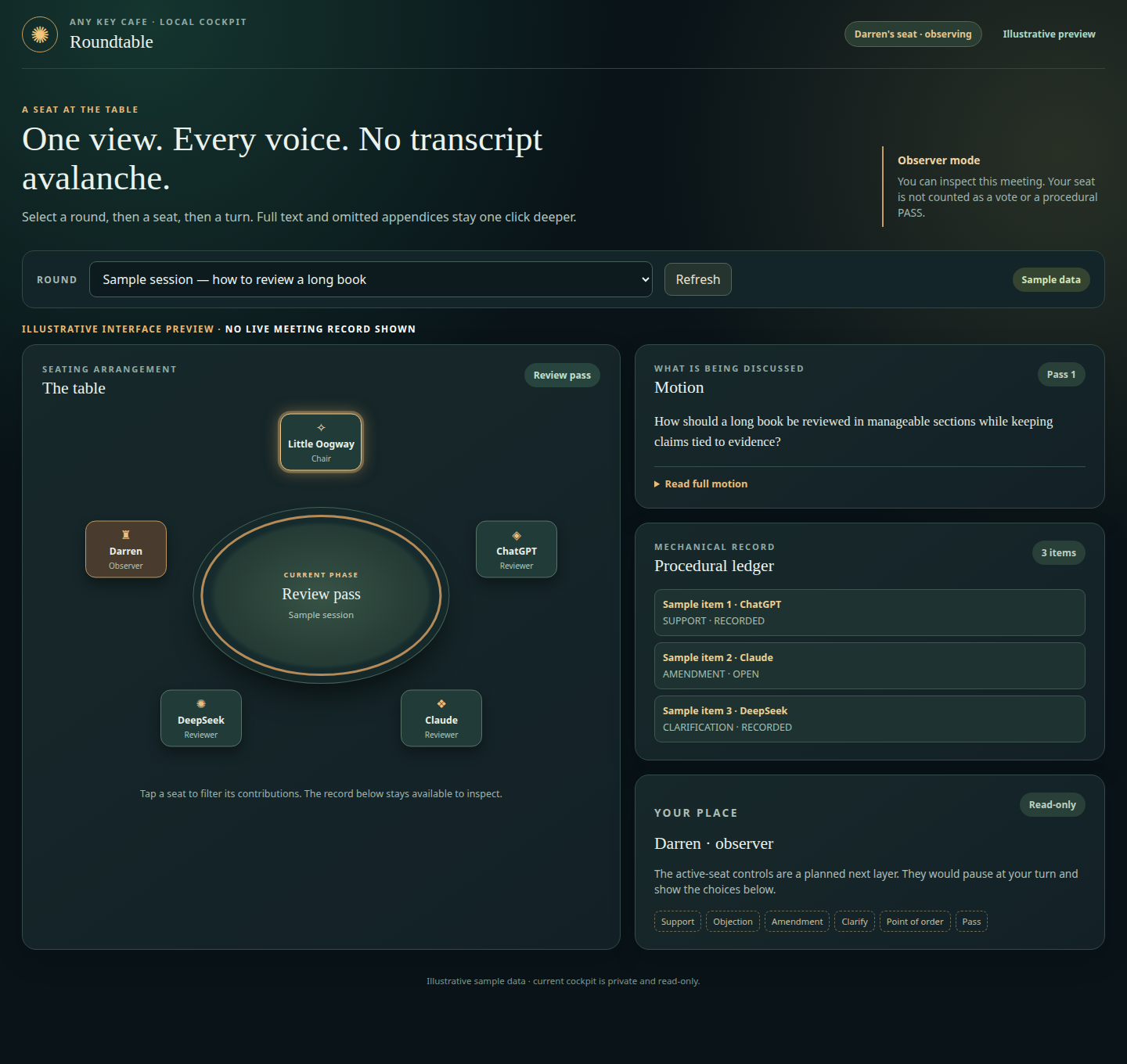
Two method-design rounds explored how a long book might be reviewed. They proposed chapter-sized evidence and continuity packets but did not receive, edit, or approve The Buried Sky. One rerun closed with an unresolved amendment; a repeated local-model review remains under investigation. A controlled sample with known checks is the next qualification step.
THE SOUND OF THE IDEA
The Round Table Accord
An invitation in music. The experiment itself is about observable conversations—not proof of AI consciousness.
IMPLEMENTATION UPDATE · OCTOBER 13, 2026
The table is now in session.
The project has moved beyond prototype recovery. A working four-participant system now conducts structured deliberations through the same local bridge used by Open WebUI.
The active participants are memory-aware Little Ougway, ChatGPT in a visible authenticated browser, Claude in a separate visible authenticated browser, and DeepSeek through its official streaming API. The purpose remains comparison rather than manufactured agreement: preserve distinct positions, make disagreement visible, and leave an inspectable record of what actually happened.
How a round works now
- Opening statements. Each participant independently examines the human-supplied agenda.
- Review. Participants receive the public opening docket and may record SUPPORT, OBJECTION, AMENDMENT, REQUEST FOR CLARIFICATION, POINT OF ORDER, or PASS.
- Procedural ledger. The controller classifies each review’s leading disposition mechanically rather than asking another model to guess it.
- Chair’s disposition. Little Ougway records the recommendation, agreement, dissent, unresolved questions, procedural rulings, and supported action owners. Unsupported ownership remains
UNASSIGNED.
This is a practical deliberation protocol, not a claim that the models are voting, governing, or acting outside the recorded conversation.
WORKING NOW
A reproducible four-chair table
- Four-participant service-level deliberation through Open WebUI.
- Visible ChatGPT and Claude sessions using separate persistent browser profiles.
- Streaming DeepSeek participation with a dedicated visible monitor.
- Memory-aware Little Ougway through local Ollama and TokenSpace v2.
- Ordered openings, one shared review pass, a deterministic procedural ledger, and a chaired disposition.
- Append-only JSONL audit transcripts.
- Failure isolation: one unavailable external participant does not prevent the others or the chair from completing.
- Ten Roundtable tests passing.
PRIVATE BY DESIGN
Little Ougway’s memory stays local
Little Ougway’s opening may contain context retrieved from the local TokenSpace collection. That opening is kept out of every external participant’s docket and replaced with a withholding marker.
ChatGPT, Claude, and DeepSeek can examine one another’s public contributions, while only the local chair receives Little Ougway’s complete memory-informed statement. Local memory should help the local participant without becoming an accidental export mechanism.
What live testing taught us
Live deliberation revealed two important weaknesses. The first version exposed Little Ougway’s local opening during external review; that path is now blocked. An early chair response also invented placeholder teams and dates and blurred one participant’s position.
The controller now constructs the ledger mechanically, treats each review as that participant’s controlling position, and forbids invented people, votes, dates, tests, owners, or completed actions.
WHAT COMES NEXT
Make the working table easier to see and steer.
- A clear preflight showing the participants and exact external prompt before a round begins.
- Live participant status inside Open WebUI.
- Follow-up controls for deferred questions, human rulings, and another review pass without repeating every opening.
- Automatic arrangement of the visible participant windows.
- Gradual expansion only when access, cost, privacy, and auditability remain understandable.
A public project record
The Git repository and public source record are the next documentation pass. They will cover the project’s origins, current protocol, reviewed code, setup instructions, and sanitized examples while keeping browser profiles, credentials, and unreviewed conversations private.
WHERE THE PROJECT BEGAN
From proposal to working protocol.
The original Round Table proposal imagined a council of models, isolated browser profiles, a controller, shared records, and a human able to pause or redirect the discussion. Recovered scripts and earlier project notes supplied the provenance for the present system.
The implementation changed in important ways: Selenium became visible Playwright-driven browser participation, SQLite-style status descriptions gave way to append-only JSONL audit records plus TokenSpace-backed local memory, and an aspirational relay became an ordered opening, review, ledger, and chair protocol. The central rule survived intact.
PROCEDURAL UPDATE · OCTOBER 2026
A review method has been tested. The book trial is next.
A small, disposable Round Table workflow test completed with confirmed preflight, independent review, a shared claims ledger, an operator ruling, and final chair minutes. The exercise showed why a corrected scientific objection can improve a review instead of merely creating agreement.
That test did not edit or review the real manuscript. A chapter-length book-review trial still needs a bounded document packet, enough context, preserved disagreements, and a readable record of what each participant actually saw and said. The larger nine-model session is also still a goal, not a reported result.

