
Foundations · geometry made physical
When Memory
Was Magnetic
Before silicon chips, computer memory was woven from copper wire and tiny magnetic rings—one physical bit at every crossing.
Look before naming it
At fifty-times magnification, a magnetic-core memory plane looks almost woven. Copper lines cross in repeating diagonals. Ferrite rings tilt between them. Every ring can hold one binary state.
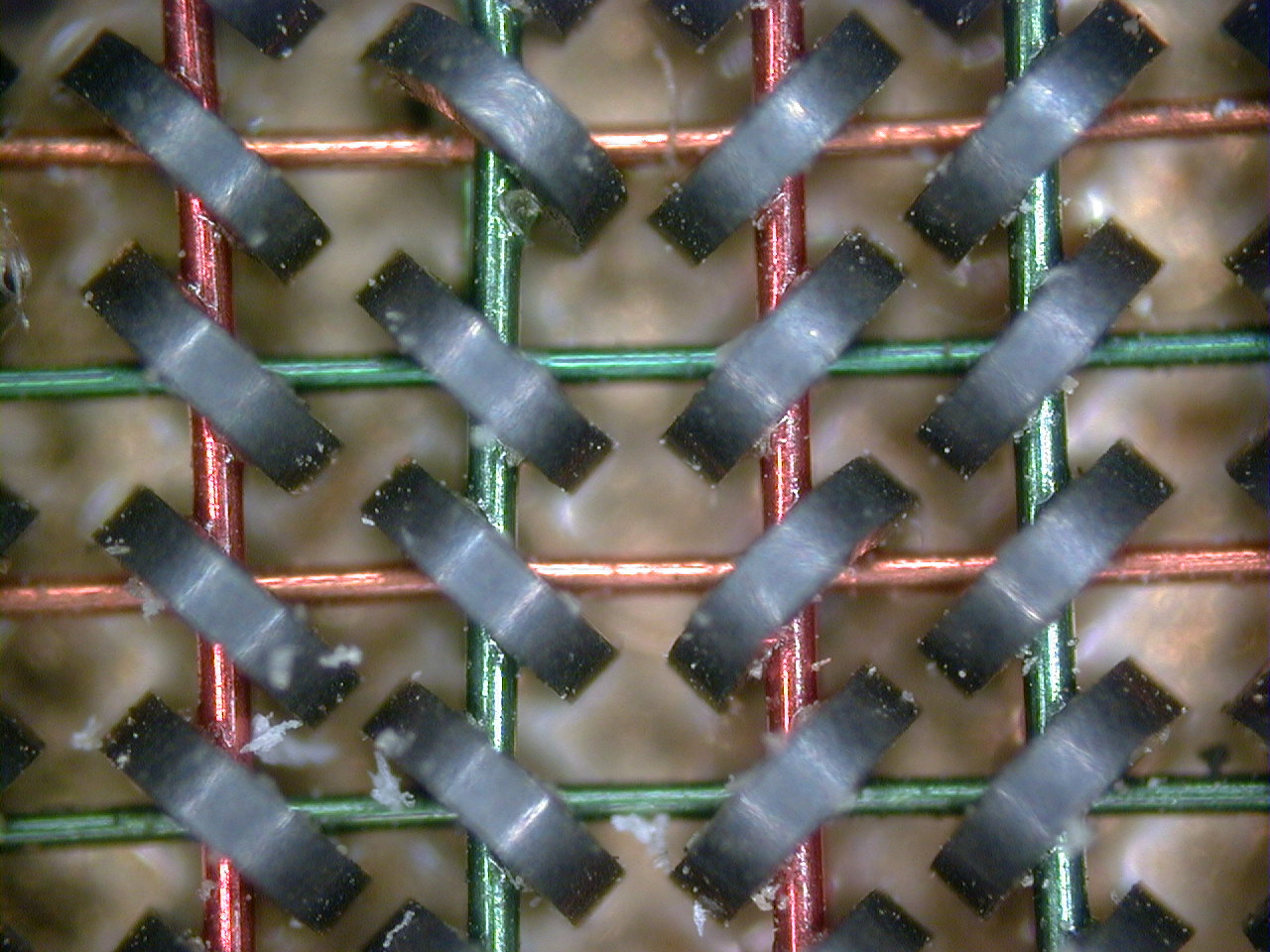
One ring, one bit
Each dark toroid is a ferrite core. Currents in two address wires combine at one crossing to select it. The direction of magnetization represents a 1 or a 0. A sense wire detects the voltage induced when the core changes state.
Store
Magnetic orientation
The bit persists as one of two stable magnetization directions, even when power is removed.
Select
Coincident current
Neither address line alone is strong enough to flip a core. Together, their fields select the core at the intersection.
Read
Change and detect
Early core reads were destructive: testing the state could reset it, so the machine rewrote the stored bit afterward.
Whirlwind made the grid practical
MIT’s Whirlwind project became the first computer to use coincident-current magnetic core memory. The Smithsonian’s surviving plane contains 1,024 cores where 32 vertical and 32 horizontal address wires meet, with a diagonal sense wire threaded through the array.
The planes were assembled by hand. The Smithsonian records that a 64×64 plane could initially take about two weeks to manufacture. Alternating the direction in which workers threaded the cores produced the dense diamond pattern visible across the plane. Later frames reduced assembly time to roughly six to eight hours.
What the geometry does—and does not—show
Established engineering
A rectangular address grid
The centers of the cores are selected by horizontal and vertical conductors. The useful logic is a coordinate grid, magnetic thresholds, and induction.
Our investigation
Diamonds, crossings, rings
Rotation of the toroids and alternating wire paths create a second visual layer of diagonals and diamonds. Tracing it may reveal useful comparisons, but it does not show that engineers encoded the Flower of Life.
The stronger observation is simpler: reliable information storage emerged from magnetism, repeated geometry, intersections, and controlled changes of state. That makes core memory a concrete neighbor to the site’s field and lattice investigations.
The related path: bubble memory
Magnetic bubble memory came later and worked differently. Instead of ferrite rings, it stored bits as tiny cylindrical magnetic domains—“bubbles”—in a thin film. Applied magnetic fields moved those domains along patterned tracks. The shared word magnetic matters; the physical mechanisms should remain separate.
This deserves a later page of its own. Here it acts as the bridge from a fixed woven lattice of cores to information carried by mobile magnetic domains.
Where it connects
Beryllium: When the Lattice Appears →
A second real system in which repeated geometry becomes physically visible—this time through crystal packing and trapped charged particles.
Flower of Life →
The geometric reference point. Similar-looking overlays become useful only after the engineering grid is described on its own terms.
3 6 9 →
The site’s inquiry into recurrence, directional relationships, and what patterns preserve as they repeat.
Laboratory →
A place to trace the photographs, define overlays, and test whether a proposed geometric relationship adds explanatory value.
Source trail
- Smithsonian National Museum of American History — Whirlwind Magnetic Core Memory PlaneArtifact history, 32×32 address grid, sense wire, hand assembly, and the documented diamond threading pattern.
- Wikimedia Commons — Magnetic core.jpgFull-resolution 50× photograph, authorship, provenance, and CC BY 2.5 license.
- Smithsonian Computer History — interview with Ken OlsenFirst-person explanation of coincident-current selection and Whirlwind’s early core planes.
Memory once had a visible body.
Every bit occupied a ring, every address followed a wire, and every change announced itself through a field. The beauty is not evidence added to the machine. It is what the machine looked like when information had to be built by hand.